Book 1 environment
Coral Maze
The Treasure of the Coral Maze
Follow the crew through living coral passages, shifting sand, and currents that turn the reef into a maze.
Real-world discoveries from the adventure
artiFACTS
Discovery 1
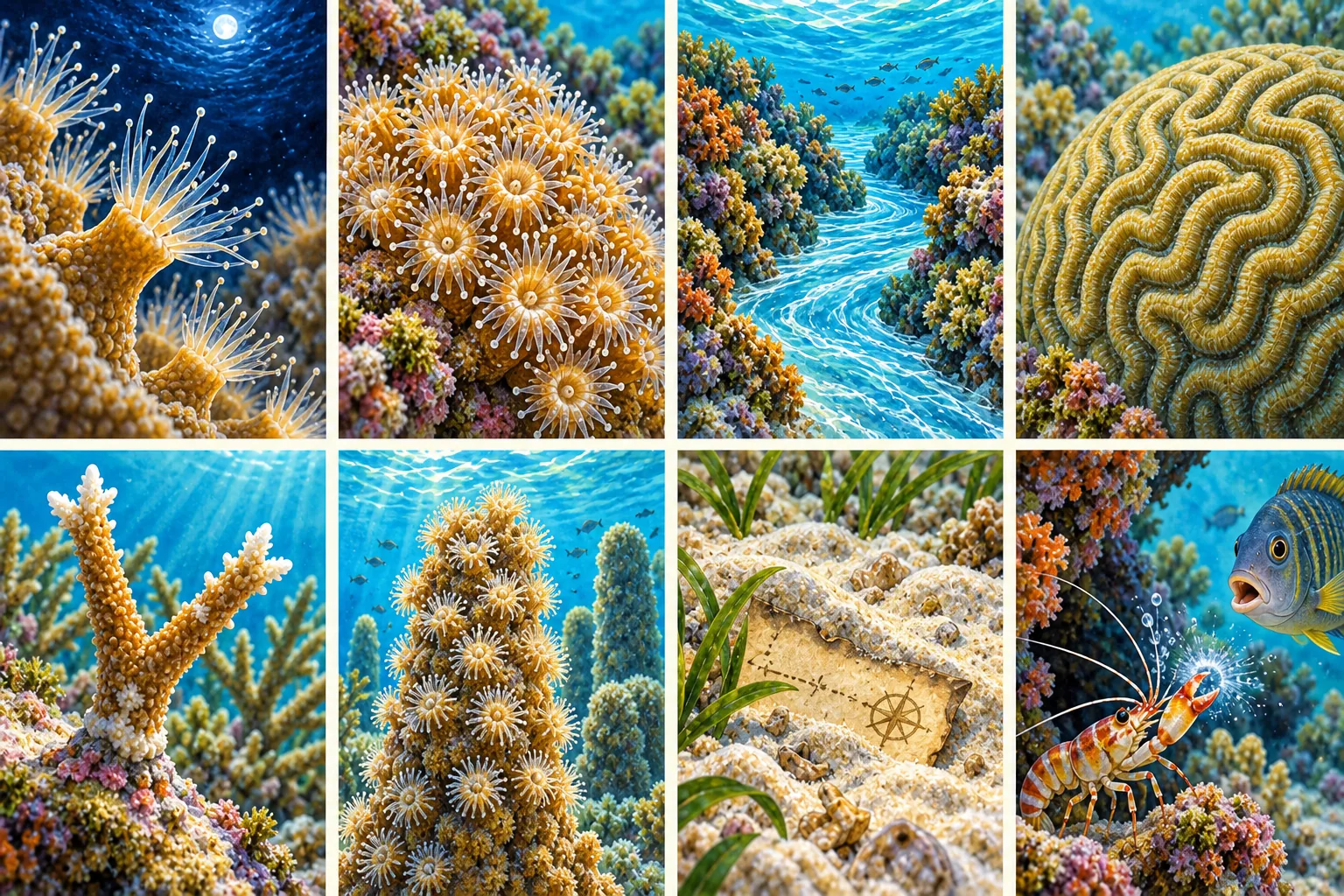
Coral comes alive after dark
Many coral polyps extend their tentacles at night to catch tiny drifting animals.
In the adventure: The maze becomes an active feeding community after Castlebury and his friends settle down for the night.
Open scientific source ↗Discovery 2
One coral can be thousands of animals
A coral colony is made of many small polyps sharing one stony structure.
In the adventure: The walls surrounding the crew are living communities rather than single creatures.
Open scientific source ↗Discovery 3
A reef can steer the water
The shape of a reef can guide currents through passes and around ridges.
In the adventure: Shelly notices that the shape of the coral changes how the water moves through the maze.
Open scientific source ↗Discovery 4
Brain coral grows a living maze
Brain corals grow winding ridges and valleys that look like a maze.
In the adventure: Brain coral becomes the first symbol in the crew’s three-part coral code.
Open scientific source ↗Discovery 5
Staghorn can grow from fragments
A healthy broken branch can sometimes attach to the reef and continue growing as another colony.
In the adventure: Staghorn coral forms the branching second clue along the route.
Open scientific source ↗Discovery 6
Pillar coral has polyps out by day
Pillar coral is unusual because its fuzzy-looking polyps are commonly extended in daylight.
In the adventure: That makes the final pillar-shaped clue feel visibly alive as the crew approaches it.
Open scientific source ↗Discovery 7
Sand can hide yesterday’s clues
Waves and currents continually shift reef sand, covering objects and uncovering them later.
In the adventure: Snap discovers the parchment only after moving water exposes its edge.
Open scientific source ↗Discovery 8
Reefs have their own soundscape
Crackling shrimp and calling fish create a surprisingly busy underwater chorus.
In the adventure: Even when the maze appears quiet, sound can carry clues about the life around it.
Open scientific source ↗