Discovery 1
A wreck can become a neighborhood
Underwater structures give reef life places to attach, hide, and shelter.
In the adventure: The Starfish begins a second life as Galleon’s thriving home.
Open scientific source
Book 3 environment
Enter a sheltered cove where a lost vessel has become a home, a landmark, and a keeper of Florida Keys history.
Real-world discoveries from the adventure
Discovery 1
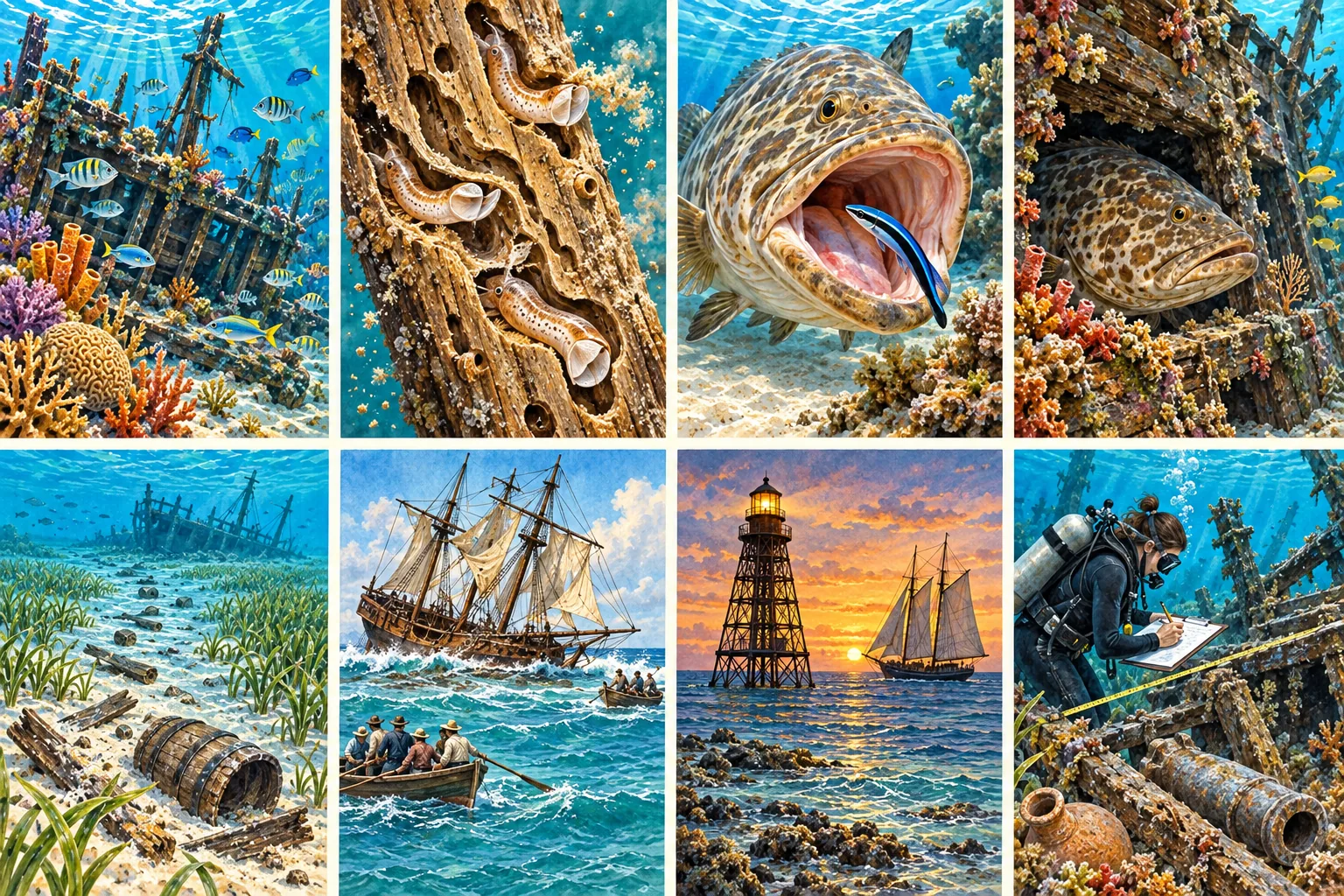
Underwater structures give reef life places to attach, hide, and shelter.
In the adventure: The Starfish begins a second life as Galleon’s thriving home.
Open scientific sourceDiscovery 2
Shipworms are clam-like mollusks that bore tunnels through underwater wood.
In the adventure: Time and marine life slowly reshape the vessel’s beams.
Open scientific sourceDiscovery 3
Cleaner fish pick dead skin and parasites from larger fish.
In the adventure: Small fish safely enter Galleon’s mouth as part of an ocean partnership.
Open scientific sourceDiscovery 4
Large reef fish often shelter around high-relief reefs, ledges, and wreck openings.
In the adventure: The broken hull gives Galleon a protected place to rest.
Open scientific sourceDiscovery 5
Floating objects can travel far from where they started, carried by ocean currents.
In the adventure: The crew follows the scattered remains backward toward the wreck.
Open scientific sourceDiscovery 6
Dangerous reefs once supported a major salvage industry centered in Key West.
In the adventure: The Starfish echoes the many voyages lost along the Florida reef tract.
Open scientific sourceDiscovery 7
Nineteenth-century reef lights helped ships identify hazards before striking them.
In the adventure: The crew’s spyglass belongs to an era when careful observation shaped every voyage.
Open scientific sourceDiscovery 8
Archaeologists study positions, materials, cargo, and construction to reconstruct a vessel’s story.
In the adventure: Every remaining object aboard The Starfish offers another clue.
Open scientific source