Discovery 1
A seed starts growing on the tree
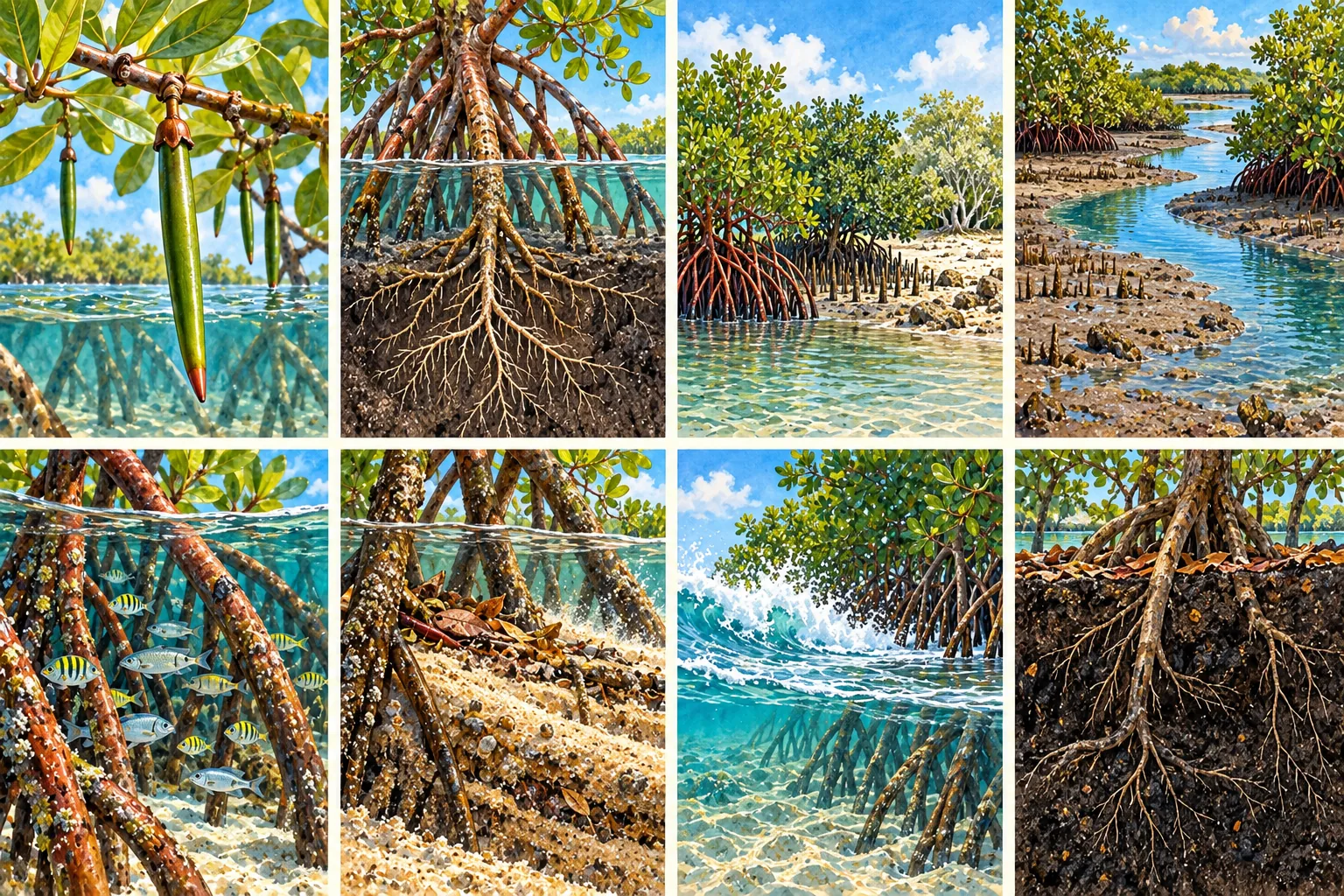
Young red mangroves, called propagules, begin growing while still attached to the parent tree.
In the adventure: A drifting young mangrove may already be ready to take root.
Open scientific source
Book 4 environment
Follow tidal channels through a root maze that protects shorelines and shelters the reef’s youngest residents.
Real-world discoveries from the adventure
Discovery 1
Young red mangroves, called propagules, begin growing while still attached to the parent tree.
In the adventure: A drifting young mangrove may already be ready to take root.
Open scientific sourceDiscovery 2
Specialized roots help mangroves obtain oxygen in waterlogged, low-oxygen mud.
In the adventure: The maze beneath the trees supports the forest above the water.
Open scientific sourceDiscovery 3
Red, black, and white mangroves are the three species commonly found in the Florida Keys.
In the adventure: The forest changes as the crew travels from open water toward land.
Open scientific sourceDiscovery 4
As tides rise and fall, the depth and flow of water through mangrove channels change.
In the adventure: Skiff’s familiar high-tide route becomes a different puzzle as the water falls.
Open scientific sourceDiscovery 5
Young fish find calm water and countless hiding places among tangled prop roots.
In the adventure: The hidden lagoon gives little fish room to grow.
Open scientific sourceDiscovery 6
Roots trap sediment and organic material, gradually raising and extending shorelines.
In the adventure: The sandy bottom around the root maze is part of a landscape still forming.
Open scientific sourceDiscovery 7
Dense roots and trunks reduce wave energy reaching the shoreline.
In the adventure: The crew feels calmer water inside the forest.
Open scientific sourceDiscovery 8
Mangrove soils can hold large amounts of carbon for long periods.
In the adventure: Much of the forest’s hidden work happens beneath the muddy bottom.
Open scientific source